A solid foundation is the backbone of any successful construction project. Whether you’re stabalising an excavation, preventing soil movement, or building deep underground structures, the right piling method can make all the difference. Sheet piling and secant piling are two of the most widely used techniques, but they serve different purposes and choosing the wrong one can lead to unnecessary costs, structural risks and project delays.
If you’re a civil engineer, project manager, or developer, you’ve likely faced this decision. But how do you determine which method is best for your project?
This guide will tell you everything you need to know. We will talk about:
- The key differences between sheet piling and secant piling
- The pros and cons of sheet piling vs secant piling
- Cost considerations when choosing between sheet piling and secant piling
- How to determine the right piling solution for your project
- Common FAQs about piling techniques
| Understanding when and why piling foundations are needed is key to a successful construction project. At Geobond, we provide all the essential information to help you make the right choice. It also includes expert advice from our highly experienced engineers, who bring over 60 years of combined construction expertise.We also take the complexity out of piling. Our Piling Design and Calculation services ensure your project meets all structural and cost-efficiency requirements—helping you make confident, informed decisions. |
The Key Differences Between Sheet Piling and Secant Piling
The primary difference between sheet piling and secant piling lies in their construction method and intended purpose:
1. Construction Method
- Sheet Piling: Made of interlocking steel or concrete sheets that are driven or vibrated into the ground, forming a continuous barrier or retaining wall.
- Secant Piling: Formed by drilling overlapping concrete piles into the ground. Primary piles are installed first, followed by secondary piles drilled between them to create an interlocking structure.
2. Purpose & Application
- Sheet Piling: Ideal for waterproof barriers and soil retention in excavation projects, such as waterfronts and basements.
- Secant Piling: Used for deep retaining walls in challenging ground conditions. It provides both soil retention and structural support, making it suitable for deeper excavations and areas with unstable soil.
In summary, sheet piling is best for water barriers and soil retention, while secant piling is used for deeper, more complex structural applications.
| Important: Choosing the correct piling method for your project should be a top priority. Selecting the wrong solution can lead to costly delays, structural risks, and unnecessary expenses. Making the right decision from the start will save both time and money, ensuring a smooth and efficient construction process. |
The Pros and Cons of Sheet Piling vs Secant Piling
Cost is a crucial factor when deciding between sheet and secant piling. While both offer structural support, their costs vary due to materials, installation, and site conditions. Understanding the differences
There are pros and cons to using each of these methods. Knowing these will be vital when choosing which one is correct for your project.
Here are some things you may need to consider:
- Ease of installation.
- Suitability for your project’s needs.
- Reusability and adaptability.
- Structural strength and durability.
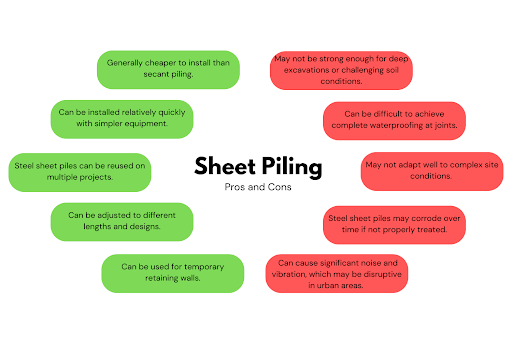
Benefits and Limitations of Sheet Piling
| Pros | Cons |
| Lower cost: Generally cheaper to install than secant piling. | Lower structural strength: May not be strong enough for deep excavations or challenging soil conditions. |
| Easy installation: Can be installed relatively quickly with simpler equipment. | Waterproofing concerns: Can be difficult to achieve complete waterproofing at joints. |
| Reusable: Steel sheet piles can be reused on multiple projects. | Limited flexibility: May not adapt well to complex site conditions. |
| Adaptable: Can be adjusted to different lengths and designs. | Potential for corrosion: Steel sheet piles may corrode over time if not properly treated. |
| Suitable for temporary applications: Can be used for temporary retaining walls. | Installation noise and vibration: Can cause significant noise and vibration, which may be disruptive in urban areas. |
Key takeaway: Choose sheet piling for simpler projects where cost is a primary concern and soil conditions are relatively stable.
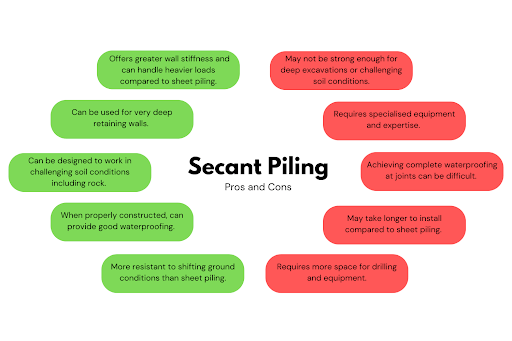
Benefits and Limitations of Secant Piling
| Pros | Cons |
| High structural strength: Offers greater wall stiffness and can handle heavier loads compared to sheet piling. | Higher cost: Generally more expensive to install than sheet piling. |
| Suitable for deep excavations: Can be used for very deep retaining walls. | Complex installation: Requires specialised equipment and expertise. |
| Adaptability to different soil types: Can be designed to work in challenging soil conditions including rock. | Potential for joint issues: Achieving complete waterproofing at joints can be difficult. |
| Watertight potential: When properly constructed, can provide good waterproofing. | Slower installation: May take longer to install compared to sheet piling. |
| Increased durability: More resistant to shifting ground conditions than sheet piling. | Larger site footprint: Requires more space for drilling and equipment. |
Key takeaway: Choose secant piling when high structural strength, deep excavations, or challenging soil conditions are required, even if it comes at a higher cost.
Cost Considerations When Choosing Between Sheet Piling and Secant Piling
Cost is one of the most important things to consider when choosing between sheet piling and secant piling. While both methods serve important structural purposes, their costs can vary significantly based on factors such as materials, installation complexity, and site conditions.
Understanding the cost differences between these to methods will help you determine the most cost-effective solution, without compromising quality.
Your piling cost will depend on a number of different factors, such as the type of piles required, the amount of piles required, the depth of piles required and more. This is why it is important to consider all of the factors below when deciding what is best.
Material & Installation Costs
Steel sheet piles (the most common type) are usually less expensive per linear meter than the concrete piles used in secant piling, especially when considering the need for overlapping in secant pile walls to achieve watertight seals.
Sheet Piling Materials: Most commonly steel, though plastic/vinyl and timber are options. Steel sheet pile costs depend on the grade, thickness, and dimensions of the sheets. Plastic/vinyl are generally cheaper but may have limitations. Typically will cost you around £50 – £200+ per linear meter. meaning it is generally cheaper and easier to install.
Secant Piling Materials: Primarily concrete and steel reinforcement. Larger diameter piles and heavier reinforcement drive up material costs significantly. Expect price variations based on concrete strength, rebar grade, and local market conditions. Typically will cost you around £100 – £300+ per linear meter. This means is is generally higher material and labour costs.
Labour & Equipment Requirements
For sheet piling, it can be installed quickly and is not as intensive as secant piling, but still requires a skilled team and specialised equipment such as:
- Excavators for site preparation and handling sheets
- Pile drivers (vibratory or impact hammers) or presses (for quieter installation)
- Cranes (if needed for handling longer sheets)
- Alignment and leveling tools
For secant piling, a highly skilled team is essential. It involves drilling, reinforcement and concrete curing, leading to longer installation times and higher labour costs, as well as the equipment below:
- Heavy-duty drilling rigs
- Cranes for lifting reinforcement cages and equipment
- Concrete pumps and mixers
- Excavators for site preparation and handling materials
Long-Term Maintenance & Durability
Both secant and sheet piling can provide long-lasting solutions, but their maintenance needs and durability can differ:
- Inspection Costs: Regular inspections are essential for both types of piling. However, the frequency and complexity of inspections might differ. Sheet piling, due to its corrosion risk, might require more frequent checks, leading to higher inspection costs.
- Repair Costs: If damage occurs, repairs can be costly. For secant piling, this might involve patching concrete or repairing reinforcement. For sheet piling, it could mean repairing or replacing corroded sections, which can be more extensive and expensive.
- Protection Costs: To enhance the durability of sheet piling, you might need to invest in protective coatings or cathodic protection systems. These add to the initial cost but can save money on repairs in the long run.
- Replacement Costs: If maintenance is neglected and significant damage occurs, you might face the cost of replacing sections of the piling. This is a major expense and can be particularly challenging with sheet piling if corrosion has weakened the structure.
| Did you know? Sheet piling can be reused across multiple projects, helping to lower the overall cost of installation. In fact, some steel sheet piles can last for decades, saving you money on future projects while still maintaining structural integrity. Contact Geobond for a free quote. |
How To Determine The Right Piling Solution For Your Project
Choosing the right piling solution for your project involves evaluating several key factors. Now that we’ve covered the main considerations, such as cost, pros and cons, and the primary purposes of piling, let’s explore additional factors that will help you make the best decision.
Soil Conditions
Soil conditions play a significant role in determining whether sheet piling or secant piling is the better option for your project. Sheet piling is often the preferred choice for stable soil conditions and situations where water retention is necessary. In contrast, secant piling is ideal for challenging ground conditions, including loose soils, rock, or highly variable soil types.
Project Depth and Size
Sheet piling is generally better suited for shallow projects or temporary applications, such as creating barriers for smaller excavations or retaining walls. Secant piling, however, is more appropriate for deep excavations and projects that require greater structural strength.
Waterproofing Requirements
Sheet piling is commonly used for water barriers but may struggle to achieve a completely watertight seal at the joints. Secant piling, when installed correctly, provides superior waterproofing, making it a better choice for projects that will be exposed to significant water pressure.
Structural Load Requirements
Sheet piling is suitable for projects with moderate load requirements where structural strength is not as critical. Secant piling, on the other hand, offers enhanced structural strength, making it ideal for deep retaining walls and projects that require the ability to bear heavy loads.
Long-Term Considerations
Steel sheet piles can be reused, which can help reduce costs for future projects. In contrast, secant piling is designed for long-term durability, offering excellent performance, particularly in challenging ground conditions.
Project Timeline
If your project is time-sensitive, sheet piling may be the better option due to its quicker installation. However, secant piling can be more time-consuming, as it requires more complex installation processes. Despite this, it is the preferred solution for deep, structurally demanding projects.
Common FAQs about piling techniques
How long does piling take?
Sheet piling installation can take several days to weeks, depending on the project’s size and complexity.
Factors that affect the time it takes to install sheet piling:
- Project size
- Project complexity
- Soil conditions
Secant piling installation generally takes several weeks to a few months, depending on the projects size and complexity.
Factors that affect the time it takes to install secant piling:
- Installation phases
- Ground conditions
- Project scale
What are the key factors that influence the cost of piling?
- Type of piling: Sheet piling is generally cheaper than secant piling.
- Material: Steel sheet piles are more common but pricier than plastic/vinyl. Concrete costs for secant piles vary with strength and mix.
- Depth and length: Deeper and longer piles require more material and labor, increasing cost.
- Ground conditions: Difficult ground (rock, unstable soil) can slow down installation and require specialized equipment, raising costs.
- Site access: Poor access can increase costs due to needing smaller, specialized equipment.
- Labor costs: These vary by location and the complexity of the project.
How long does piling last?
Both sheet and secant piling can be durable solutions:
- Sheet piling: Steel sheet piles are prone to corrosion, so their lifespan depends on the environment and any protective measures taken. Plastic or vinyl sheet piles are corrosion-resistant but may have lower load capacity.
- Secant piling: Concrete secant piles are generally very durable and can last for many decades with minimal maintenance.
Is piling noisy?
Sheet piling, especially when driven into the ground, can be quite noisy. Secant piling is generally quieter because it involves drilling rather than hammering. However, the specific equipment used can influence noise levels.